

Cango logo
Cango logo
Menu
Smartphone scanning a passport-style ID card and utility bill on a dark desk under a warm orange lamp

Cango Verification: KYC without delays step by step

Updated: 10 November 2026

Before your first cashout leaves the cashier, cango verification is a mandatory step for every Kiwi player. Because there is no NZD in the cashier, all account balances and limits are handled in AUD or EUR, starting with a minimum withdrawal of $30 AUD. Cango runs its identity checks through the Sumsub platform to keep your profile secure and confirm you are over 18. The process usually takes 24 to 48 hours excluding weekends, and knowing exactly which files to upload saves you from frustrating delays when you want to collect your pokies winnings.

Cango verification: documents at a glance

Kiwi players often ask what paperwork they need to gather before clicking the withdrawal button. The cango verification system uses Sumsub, a document checker built right into your account profile. You cannot request a payout until this check is marked as approved. Getting your files ready right after you register and make your first $15 AUD deposit (or $45 AUD if you claim the welcome bonus with code WP1) is the smartest way to avoid waiting later.

Document TypeCore RequirementsTypical Review Time
Photo ID DocumentValid passport, national ID card or another photo ID showing full name, birth date and expiryUp to 48 hours (excluding weekends)
Proof of AddressUtility bill, bank statement or government letter dated within the last 90 daysUsually 24 to 48 hours
Selfie with IDLive photo holding your chosen photo ID next to your face with all text readableUp to 48 hours (excluding weekends)
Payment Method ProofPhoto of your Visa or Mastercard (middle digits covered) or crypto wallet screenshotAround 24 to 48 hours
Source of FundsBank statement, payslip or proof of savings requested on high turnoverTypically 24 to 48 hours

Once you open the verification tab in your account settings, Sumsub guides you through each upload step by step. For your primary identity check, a New Zealand passport, national ID card or another photo ID works best. After uploading the document, the interface prompts you to take a selfie holding that exact ID to confirm the account belongs to you. Because Cango allows only one account per person, household and device, the system cross-checks these details automatically. Send your files between Monday and Thursday so the 48-hour review window does not run into a weekend pause.
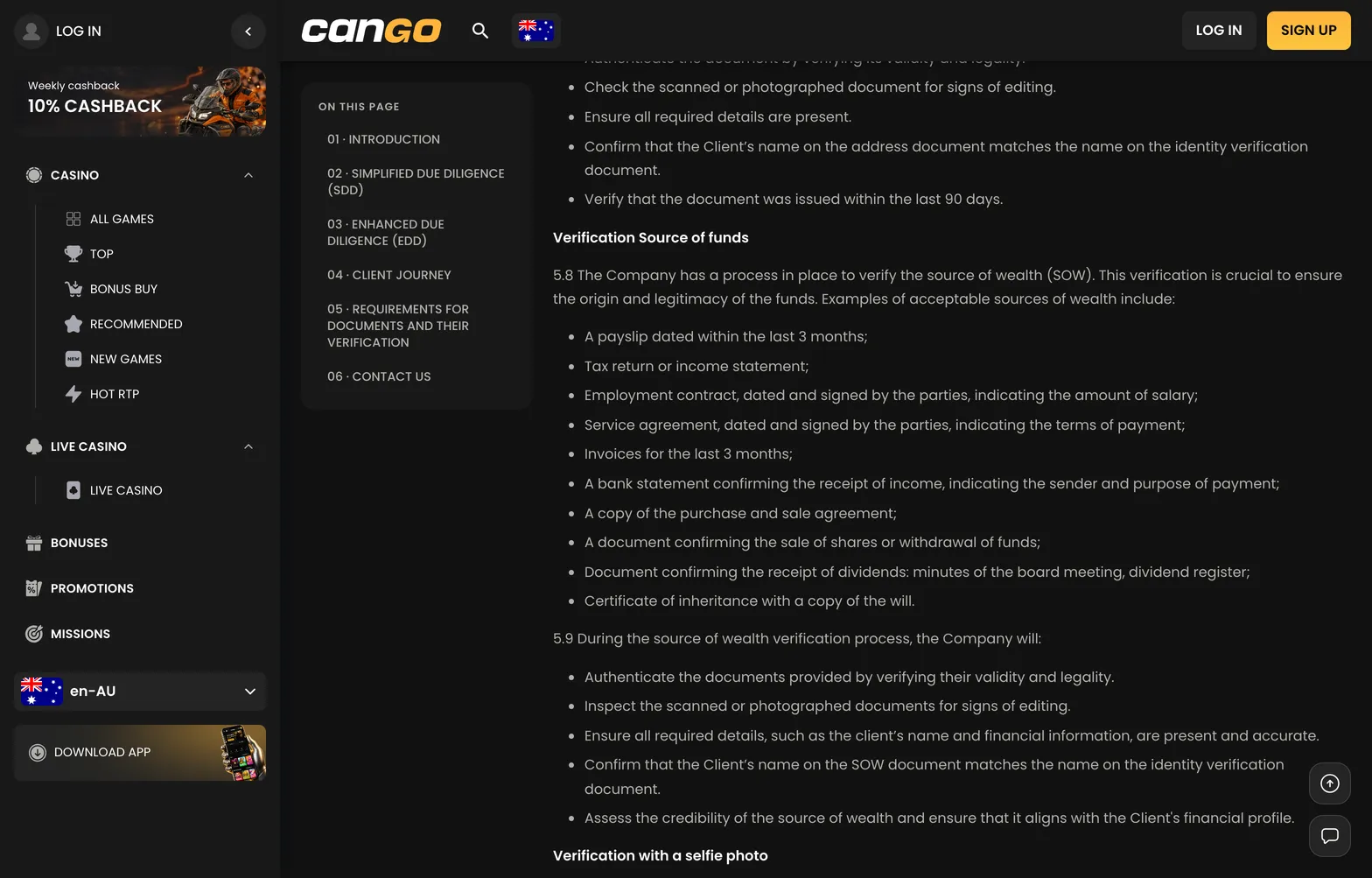
Cango KYC verification policy page listing the documents needed before a withdrawal

The Cango KYC page sets out the three standard uploads, photo ID, proof of address under 90 days old and a selfie with the document, plus source of funds on request.

Cango KYC: rejected uploads

Nothing slows down a cashout faster than having your files bounced back by the checker. When Kiwi players run into a cango kyc delay, it is almost always due to a simple formatting mistake or an old bill rather than an issue with the account itself. Sumsub scans the corners, text sharpness and issue dates of your files before a human reviewer looks at them.

  • Address proof older than 90 days is the number one reason for a rejection. If you upload an electricity bill, water bill or bank statement, check the issue date at the top of the page; anything dated more than three months ago is declined automatically.
  • Cropped edges cause the next most rejections. Every edge of your passport, national ID card or another photo ID must sit inside the camera frame, and a finger over the corner of a paper statement flags the file as incomplete.
  • Glare from overhead lights can hide your surname, birth date or document number on plastic cards and laminated passport pages. Take your photos in daylight near a window with the flash turned off.
  • Your profile name and residential address must match your documents word for word. Never leave a VPN running while you complete the Sumsub steps, as VPN use is banned and creates location conflicts during the review.
  • A blurry selfie is the last common problem: most phone cameras focus on either your face or the card. Hold the document right next to your cheek so both stay sharp.

If a file is rejected, you do not have to guess what went wrong. The verification window shows a short note, or you can open the 24/7 live chat, where support replies in about 2 minutes and tells you which photo needs a retake.

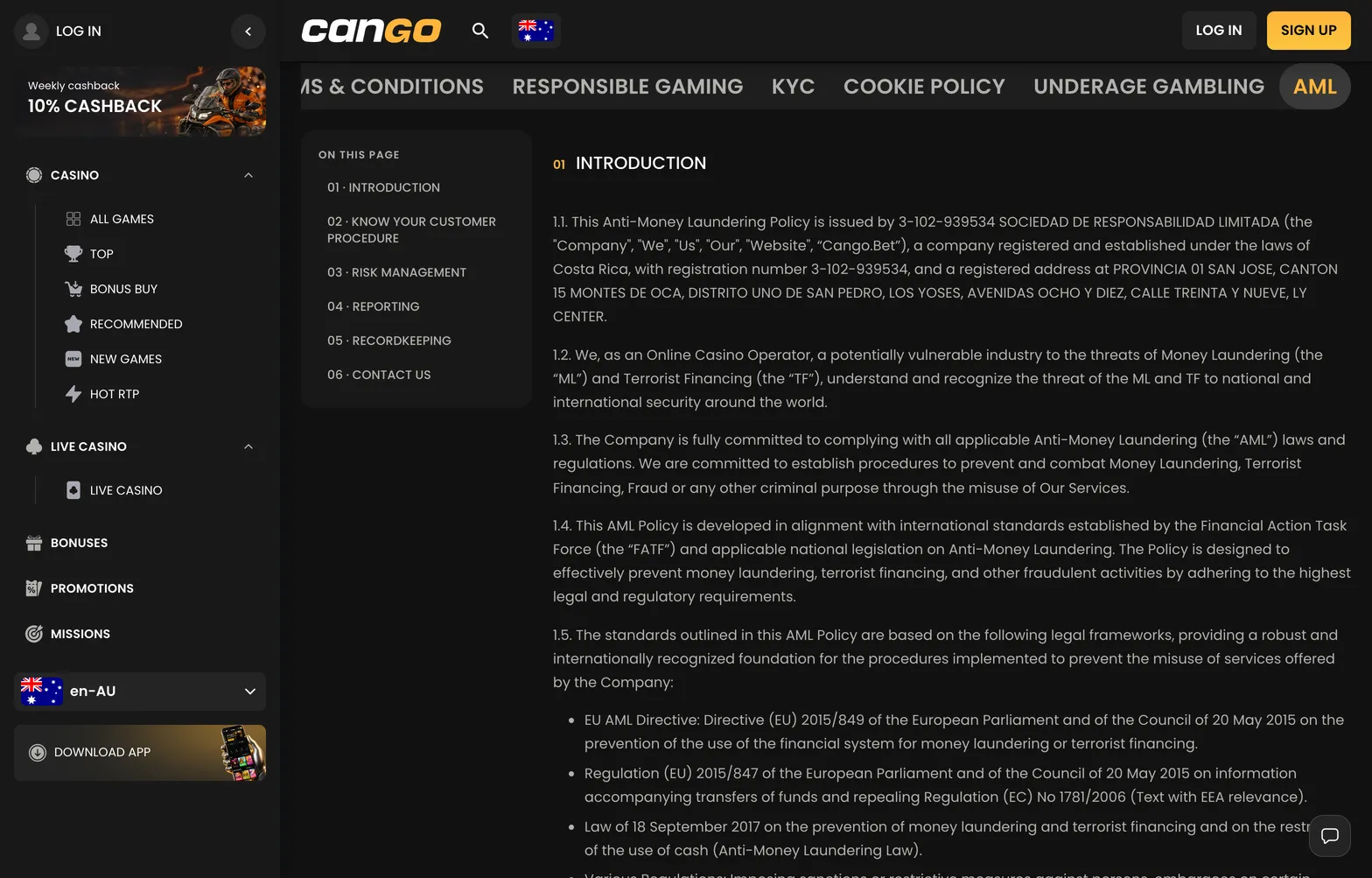
Cango anti-money laundering policy page in the casino Policy Centre

A source of funds check is part of Cango’s anti-money laundering rules and usually appears only after large deposits or withdrawals close to the weekly cap.

Cango verification: source of funds

For most casual players cashing out $100 AUD or $500 AUD, the basic photo ID, address proof and selfie are all you ever need. However, if you hit a major streak on the pokies or move large sums through the cashier, the security team can ask for a source of funds check. It is much easier to snap and upload these extra statements straight from your phone using the Cango app than to move PDFs to a desktop computer. This secondary check is standard when your deposits or withdrawals approach the weekly limit of $8,000 AUD or the monthly cap of $22,000 AUD.

Example (illustration): a player deposits $1,200 AUD over three weeks, triggers a big bonus round, and requests a $7,500 AUD payout via Visa Original Credit Transfer, followed by a $2,500 AUD request the next week, so total withdrawals reach $10,000 AUD. Because the first request sits close to the weekly cap, the finance team will typically pause it and ask where the deposit funds came from.

Satisfying a source of funds request is straightforward if you send clear financial records. Suitable documents include a recent payslip, a personal bank statement showing regular salary credits, a statement of savings, or paperwork proving the sale of an asset such as shares or property. Make sure your full name and the dates are visible on the PDF or screenshot. Once submitted, the team reviews the paperwork within 24 to 48 hours, releases your pending withdrawal, and sends your payout on its way with no casino fees.

Cango KYC: still unsure?

  • What documents do I need for Cango verification?

    Kiwi players need to provide a valid photo ID such as a passport or national ID card along with a recent proof of address. The Cango KYC check is handled through the Sumsub system inside your account profile. You only may need to show a source of funds document if the finance team requests it later.

  • How long does the Cango KYC check take?

    The identity check takes up to 48 hours from the moment you submit your files through Sumsub. In practice, most Kiwi players get their accounts approved within 24 to 48 hours if the photos are clear and easy to read. Completing this step early helps avoid delays when you request a cashout of $30 AUD or more.

  • Do I have to take a selfie for Cango verification?

    Yes, the Sumsub system asks for a selfie of you holding your photo ID document during the upload process. Make sure your face and all corners of the ID are clearly visible in good lighting without any glare. If you run into trouble with the camera, the 24/7 live chat team usually replies in about 2 minutes to help out.

  • How old can my proof of address be for Cango KYC?

    Your proof of address document must be dated within the last 90 days when you upload it for Cango verification. A recent utility bill or bank statement showing your full name and New Zealand residential address works well. Older documents will get rejected by the system, which slows down your cashout approval.

  • When does Cango ask for source of funds documents?

    Source of funds is only requested on occasion, typically when you make large deposits or reach higher cashout limits like $8,000 AUD a week. You will also need to verify that any Visa, Mastercard, or crypto wallet used in the cashier belongs to you. Keeping screenshots of your payment methods handy makes this extra check much faster.